Guides / November 06, 2026
How Do I Keep DFARS Records When a Contract Ends?
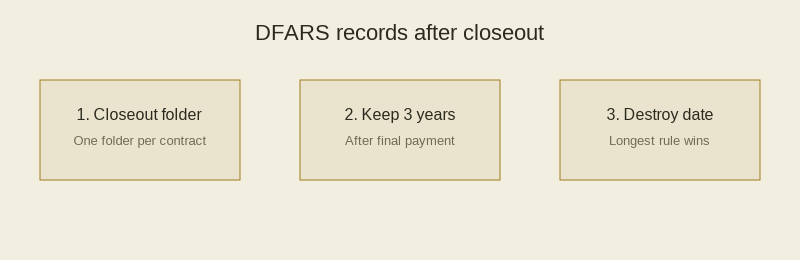
Your contract ended, but the records cannot go in the shredder yet. The government can still ask for them, and the clock runs for years. Keep the right files, and know when each one can go.
The Defense Federal Acquisition Regulation Supplement (DFARS) sets the cyber rules for defense contracts. Clause 252.204-7012 covers contracts that carry Controlled Unclassified Information (CUI). It does not set the record clock. The clock comes from the Federal Acquisition Regulation (FAR) and from your contract terms.
FAR subpart 4.7 sets the base rule. Contractors must make records available for 3 years after final payment. Some records carry longer periods under FAR 4.705. A clause in your contract can set a longer period still.
Which records to keep
Keep the contract file first: the signed contract, each change, and the final payment record. Keep the System Security Plan (SSP) that covered the contract. Keep each self-assessment score and the Supplier Performance Risk System (SPRS) posting that went with it.
Keep the incident file too. DFARS 252.204-7012 calls for a report to the Department of Defense within 72 hours of finding a cyber incident. Keep each report, each receipt, and each follow-up note. Keep the training records for staff who handled CUI. Keep the access logs for the systems that held CUI.
How long each record lasts
Use 3 years after final payment as the floor. Check each record type against FAR 4.705 before you set a date. Payroll records run 4 years. Some financial records run 4 years. Time cards run 2 years. The longest rule wins for that record.
Check the contract for a longer period. Some contracts name 5 years or 6 years for the contract file. A longer clause beats the FAR floor. Write the longer date on the file, not the floor.
How to store records after closeout
Move the files to one closeout folder per contract. Name the folder with the contract number and the final payment date. Keep a one page index inside the folder. The index lists each record, its date, and its destroy date.
Keep CUI out of the closeout folder unless the folder meets the same safeguards. CUI stays protected after the contract ends. If the folder holds CUI, keep the access rules and the encryption that guarded it during the work.
Do not delete records early to save space. FAR 4.703 says contractors must not destroy, discard, delete, or write over computer data during the retention period. An early delete is a finding, not a cleanup.
What to do this week
Pull the final payment date for your last closed contract. Build the closeout folder and the one page index. Mark each record with its destroy date. Then check the contract for any clause that sets a longer period.
Sources
- DFARS 252.204-7012, Safeguarding Covered Defense Information and Cyber Incident Reporting, acquisition.gov.
- FAR Subpart 4.7, Contractor Records Retention, acquisition.gov.
- NIST SP 800-171 Revision 2, National Institute of Standards and Technology.
- Original diagram by PolicyCortex.
Next step
Want your compliance records tied to live evidence instead of folders? See how PolicyCortex collects them automatically.