Guides / November 02, 2026
How Do I Handle a Subcontractor That Cannot Meet DFARS 252.204-7012?
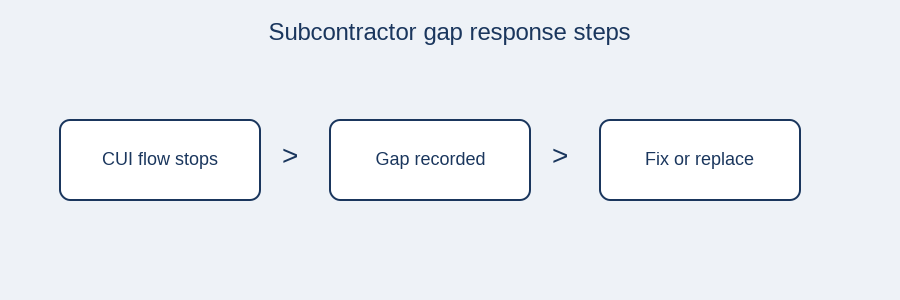
A subcontractor tells you it cannot meet a security requirement. Your first move matters more than your anger. Contain the risk, then decide.
Defense Federal Acquisition Regulation Supplement (DFARS) clause 252.204-7012 covers safeguarding. It applies to covered defense information on contractor systems. It requires flow down to subcontractors that handle that information.
Step one: stop new exposure
Pause any new flow of covered defense information to that subcontractor. Check what information it already holds. Check which of its systems hold that information.
This pause is not a punishment. It is a control while you learn the size of the gap. Document the date and scope of the pause.
Tell your prime contact early if you are a subcontractor yourself. Early notice beats a surprise found in an audit. Keep the notice factual and short.
Step two: pin down the exact gap
Ask for the specific requirement the subcontractor cannot meet. Ask for its current safeguard in that area. Ask what it would take to close the gap.
A gap in multifactor access differs from a gap in incident reporting. Each gap needs its own fix and its own timeline. A vague gap statement helps no one.
Ask for its System Security Plan (SSP) for the work. Ask for its self assessment score if it has one. Compare those records with what it told you.
Step three: choose a path for each gap
Three paths cover most cases. Pick one per gap, not one for all gaps.
Path one is a fix with a date. The subcontractor commits to a fix and an owner. You track it like your own open item.
Path two is an interim control. The subcontractor limits access or adds monitoring. The interim control stays until the real fix lands.
Path three is a change in scope. The subcontractor stops handling that information. You move the work to a source that can meet the clause.
Record the chosen path in writing. A verbal promise will not survive staff change. A dated note will.
Step four: protect incident reporting
The clause requires rapid incident reporting to the Department of Defense (DoD). It also requires the subcontractor to report incidents to you. Confirm that chain still works during the gap.
Test the chain with a simple question. Ask who at the subcontractor reports an incident. Ask how fast that report reaches you. Fix a broken chain at once.
Keep records of every notice and response. Those records prove you managed the gap. They also prove you did not ignore it.
What to do this week
List each subcontractor that handles covered defense information. Mark any known gap beside its name. Give each gap an owner and a next check date.
Sources
- DFARS 252.204-7012, Safeguarding Covered Defense Information, acquisition.gov.
- NIST SP 800-171 Revision 2, National Institute of Standards and Technology.
- Original diagram by PolicyCortex.
Next step
Want subcontractor gaps tracked beside your own evidence? See how PolicyCortex collects it from live systems.