Guides / October 31, 2026
Do I Need One SSP for the Company or One for Each Contract?
You won a second contract, and now a simple question blocks you. Do you write a whole new security plan, or reuse the one you have? The answer follows your systems, not your contract count.
A plan describes a system, not a contract
DFARS means Defense Federal Acquisition Regulation Supplement. Clause 252.204-7012 requires adequate security on each covered contractor information system (DFARS 252.204-7012). A covered contractor information system is a system that processes, stores, or transmits covered defense information. Covered defense information is defense information that needs safeguarding.
NIST SP 800-171 Revision 2 sets the security requirements for those systems. NIST means National Institute of Standards and Technology. Requirement 3.12.4 requires a System Security Plan, called an SSP, for each system (NIST SP 800-171 Revision 2). The SSP describes the system boundary, the operating environment, how each requirement is met, and connections to other systems.
Note the unit in both sources. It is the system, not the contract. That one fact answers most of the question.
One system, one plan, several contracts
If two contracts use the same system, one SSP can cover both. The same servers, the same network, and the same access rules mean the same security story. Writing that story twice adds work and adds drift. Two copies will disagree within a year.
Add a contract map to the single SSP. List each contract that uses the system. List the data each contract brings into the system. List any contract specific rule that changes how data is handled. The map lets a reviewer see which contracts sit on this system, without a second plan.
Update the map when a new contract arrives. Do not rewrite the whole plan for a new contract on the same system. Add the contract line, check for new data types, and reissue the plan version.
Separate systems need separate plans
If a second contract uses a different system, it needs its own SSP. A separate cloud tenant is a separate system. A separate office network with its own controls is a separate system. Shared staff does not merge two systems into one.
The test is simple. Would a control change in one place leave the other place unchanged? If yes, you have two systems. If a firewall rule change hits both contracts at once, you likely have one system.
A company can also split one plan into clear system sections. Each section must stand alone, with its own boundary and its own control details. If the sections share pages and blur together, split them into separate plans. Clarity beats brevity here.
What to do this week
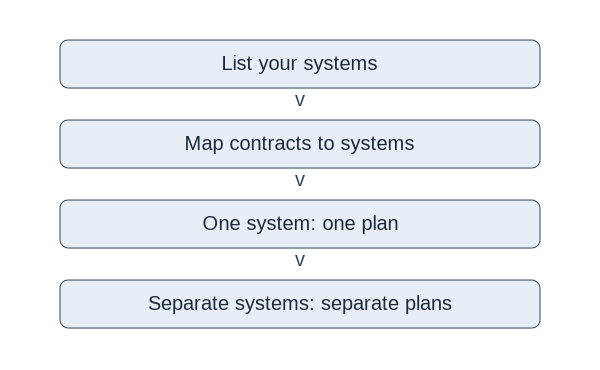
First, list your systems that hold covered defense information. Name each system, its boundary, and where its data lives. Second, map each contract to the systems it uses. Third, count the systems, not the contracts. That count is your SSP count.
If the count is one, keep one plan and add the contract map. If the count is two or more, write one plan per system. File each plan with its own version history, so changes to one system never rewrite another system's story.
Next step
PolicyCortex collects evidence from live Azure configuration using 33 collectors. The collectors read conditional access, diagnostic settings, Defender posture, backup, and firewall. The evidence is evaluated against NIST 800-53 and NIST 800-171. It supports re-verification after remediation. It generates SSP, SAR, and POA&M output from collected evidence. SAR means Security Assessment Report. POA&M means Plan of Action and Milestones. PolicyCortex is strongest in commercial Azure, and AWS is covered. Start at https://policycortex.com.
Sources
- DFARS 252.204-7012, Safeguarding Covered Defense Information and Cyber Incident Reporting, Defense Federal Acquisition Regulation Supplement. https://www.acq.osd.mil/dpap/dars/dfars/html/r20150326/252204.htm
- NIST SP 800-171 Revision 2, Protecting Controlled Unclassified Information in Nonfederal Systems and Organizations, National Institute of Standards and Technology. https://doi.org/10.6028/NIST.SP.800-171r2