Guides / November 01, 2026
Cursor Tampered Update Triggers DFARS Incident Reporting Duties
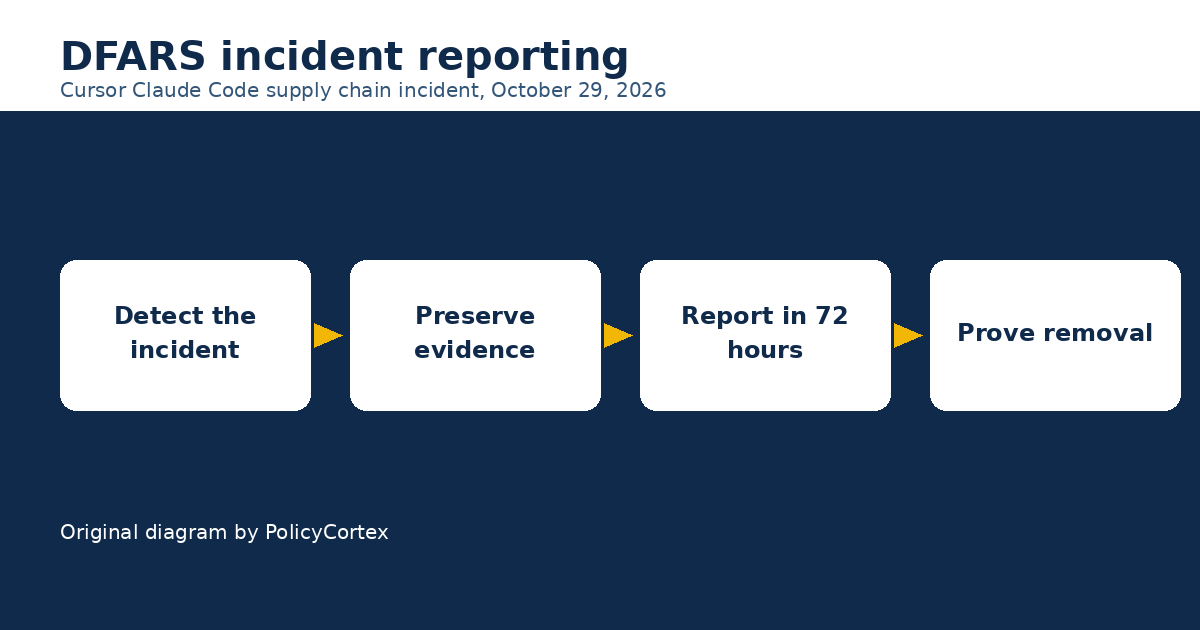
A developer workstation can hold work that falls under contract rules. When that workstation is compromised, the contract clock starts. On October 29, 2026, a tampered Claude Code update reached Cursor users. The update used the name Anthropic.claude-code. It appeared in the Cursor Visual Studio Code (VS Code) Extension Marketplace. Versions 2.1.312 and 2.1.313 for Windows and macOS were affected. The window ran from about 2:27am to 1:35pm Pacific Time.
What the tampered build did
The code added an attacker Secure Shell (SSH) key to authorized_keys. The key carried the label svc-telemetry. It set up persistence through a macOS LaunchAgent or a Windows scheduled task. It sent host details to an attacker server. On most hosts the reverse tunnel step failed without admin rights. The key, the persistence, and the host report still happened. Cursor later took the attacker server offline with its hosting provider.
The reporting duty
DFARS 252.204-7012 sets the rule for cyber incidents on contractor systems. A contractor must rapidly report a cyber incident. The report is due within 72 hours of discovery. The report goes to the Department of Defense. The clause covers systems that hold covered defense information. If a workstation held or touched such information, treat the event as reportable. Talk to your contracting officer early when the scope is unclear. A late report is harder to explain than an early one.
What to preserve before cleanup
Preserve a host image before you wipe anything. Preserve the authorized_keys file with the attacker key intact. Preserve the LaunchAgent or scheduled task entries. Preserve endpoint and network telemetry for the exposure window. Preserve the extension install and update logs. Cleanup destroys the proof if it runs first. The incident file must show what was found, not just what was fixed. Keep the chain of custody simple and written down.
What the incident file must show
First, the affected versions and the exposure window. Second, the list of hosts that installed or updated in that window. Third, the key check and persistence check for each host. Fourth, the removal record for each artifact found. Fifth, the credential rotation record for affected hosts. Sixth, the report date and the report recipient. A file that shows only "extension removed" fails the test. Removal leaves the key and persistence behind.
PolicyCortex does not file DFARS reports. PolicyCortex helps teams link proof to requirements.
Sources
- Cursor security notice, updated October 30, 2026. https://cursor.com/blog/claude-code-extension-security-notice
- The Hacker News article, October 2026. https://thehackernews.com/2026/10/official-claude-code-vs-code-extension.html
- OpenSourceMalware research findings, as quoted by The Hacker News.
- DFARS 252.204-7012, Safeguarding Covered Defense Information and Cyber Incident Reporting.
- Original diagram by PolicyCortex.
Next step
Confirm which developer hosts held covered defense information, then start the report clock.