Guides / November 06, 2026
Cold Chain Attacks and DFARS 252.204-7012 Reporting
A joint advisory dated November 5, 2026 warns about refrigeration controllers. The Cybersecurity and Infrastructure Security Agency (CISA) signed it. The Federal Bureau of Investigation (FBI) signed it. The Department of Health and Human Services (HHS) signed it too. The Department of Agriculture (USDA) and the Department of Transportation (DoT) signed it as well. The Internet Crime Complaint Center (IC3) published the advisory.
Attackers target electronic temperature controllers. They target commercial refrigeration controllers in grocery and cold storage sites. These are operational technology (OT) devices. A changed setpoint can spoil inventory. It can shorten equipment life. It can create a fire hazard. It can hide true temperatures from staff.
The advisory names three ways in. Authentication bypass is first. Arbitrary code injection is second. Weak configurations are third. The advisory names no vendor. It gives no victim counts. It attributes the activity to no group and no country.
Reporting adds scale. Reuters, via TechCrunch and BleepingComputer, reported an October 12 wave that hit an estimated 250 to 350 French supermarkets. Attackers remotely activated defrost and raised temperatures. A second wave in early November affected more than 115 stores across six European countries. The US Department of Defense is investigating suspected hacks at military base freezers. These details come from reporting, not from the advisory.
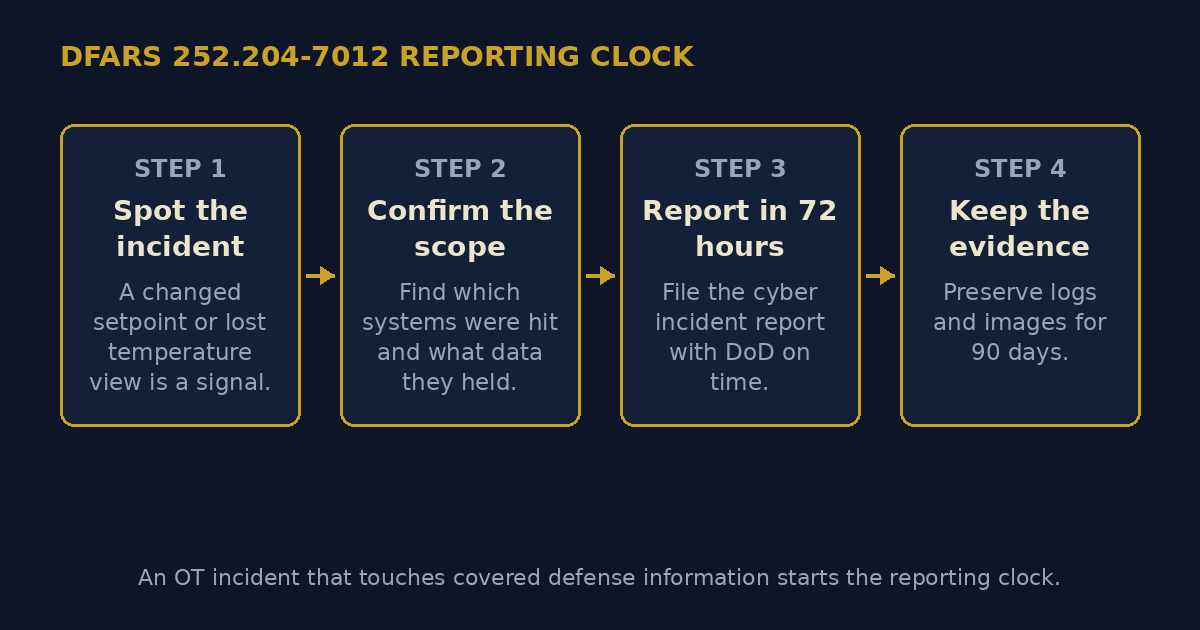
For defense contractors, the lesson is the reporting clock. DFARS 252.204-7012 requires rapid reporting of a cyber incident. The rule covers incidents that affect covered defense information. An OT incident can qualify when it touches a covered system or covered data. A changed setpoint or a lost temperature view is a signal, not a shrug. Teams must confirm the scope fast. They must find which systems were hit and what data they held. Then they must file the report within 72 hours. They must preserve evidence for 90 days.
The advisory lists the fixes. Eliminate public internet exposure. Isolate OT devices on a dedicated virtual local area network (VLAN). Change default passwords. Enforce strong password policies. Use phishing resistant multi-factor authentication (MFA) where feasible. Apply patches. Retire end of life devices. Allowlist only the Internet Protocol (IP) addresses and devices that need access. Keep current offsite and offline backups. Turn on logging. Review setpoint ranges.
Prevention and reporting go together. Isolated controllers are less likely to start an incident. Logged controllers are easier to scope when one happens. Dated records prove the report was filed on time. PolicyCortex does not patch controllers. PolicyCortex helps teams link proof to requirements.
Sources
- CISA, FBI, HHS, USDA, DoT, "US Government Partners Urge Hardening Industrial Refrigeration and Cold Chain Monitoring Systems," IC3 joint Cybersecurity Advisory, November 5, 2026, https://www.ic3.gov/CSA/2026/261105.pdf
- Reuters via TechCrunch and BleepingComputer, reporting on the October and early November waves and the US Department of Defense investigation.
- Original diagram by PolicyCortex.
Next step
Confirm today whether your refrigeration controllers connect to any system that holds covered defense information, and record the answer.